
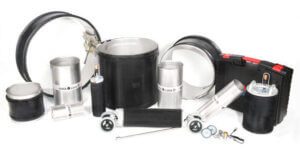
Quick-Lock BIG – Large-Diameter Pipe Repair Sleeve
Quick-Lock BIG is a 200 mm-wide stainless steel (AISI 316L) sleeve with an EPDM compression seal for permanently sealing leaking pipe joints and radial/longitudinal cracks in large-diameter pipes and manholes (DN 800–1800). When expanded, the sleeve creates a sealed area of approx. 120 mm around the defect.
What problems does Quick-Lock BIG fix?
Quick-Lock BIG seals leaking pipe joints plus radial and longitudinal cracks within large-diameter pipelines and manholes. It’s intended for structural defect sealing where excavation is undesirable or impossible.
How is the sleeve built and what materials are used?
The system combines a corrosion-resistant AISI 316L stainless steel sleeve with an EPDM compression seal. This design maintains a durable mechanical compression against the host pipe wall after installation. The system is suitable for municipal wastewater applications; always verify suitability for industrial or heavily polluted effluent environments.
Description of the Quick-Lock BIG system
Intended use
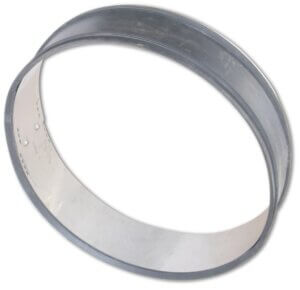
The Quick-Lock BIG sleeve is a product for permanently and tightly sealing leaking pipe joints, radial
cracks, and longitudinal cracks in large pipes and manholes of DN 800 and larger.
- The sleeve is 20 cm wide.
- The sealed area (between the circumferential seals) is approximately 12 cm.
(The distance between the circumferential seals is approximately 14 cm. However, these are
pulled together when the jacket is expanded so that the sealed area is 12 cm wide.)
The system is made from V4A stainless steel of grade 1.4404 (AISI 316L)
and an EPDM compression seal.
- The materials used are permanently resistant in municipal wastewater systems.
- Their suitability must be ascertained for use in industrial or polluted wastewater.
Components and functions
| System components | |
|---|---|
|
 |
|
|
How to use the system
Preparation
Inspecting the pipe
Before using Quick-Lock BIG, the pipe must be inspected to ascertain whether it can be repaired with the system.
Preparing the damaged area
Before installing the Quick-Lock BIG sleeve, the damaged area must be prepared as follows:
- Manually remove all protruding obstacles (seals, roots)
- Manually even out any joint misalignments of more than 0.5 cm using special mortar.
In some circumstances, using epoxy resin for reprofiling may only be possible when the concrete is wet, but not soaked through. Generally, we do not recommend it.
Recommended mineral mortars:
- Sealt-Tec P
- Ergelit S100
- Ombran MHP 15
Flowing water (infiltration) always poses problems.
- Therefore, stop the infiltration in advance using plugging mortar.
- Even out any corroded, porous inner pipe surfaces in the area to be sealed using special mortar.
Equipment and materials
Installation tools
(Supplied by Uhrig)
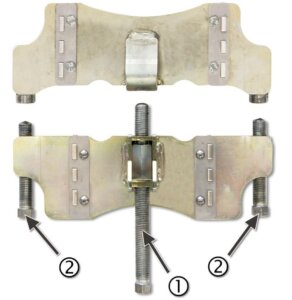
Four clamping tool sections
- 2 x with screw unit
- 2 x with seat
(1) Spindle
For pre-tensioning the sleeve
(2) Clamping screws
For clamping the sleeve and
pressing it in place
(3) Retaining lug
For attaching the tool to the
sleeve
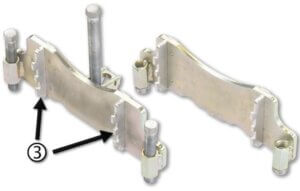

Depending on the pipe diameter, the retaining lugs (3) on the installation tool may have to be changed.
These parts are supplied with the tools.
The retaining lugs must be mounted as illustrated (3).
Required accessories
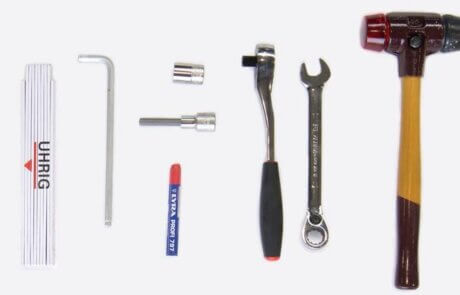
Make sure you have the necessary tools.
If necessary we can provide the tools for sale or hire.
Lubricant
- Ruler or tape measure
- 8 mm Allen key
- 17 mm socket
- Crayon
- Interchangeable socket wrench (or 17 mm ratchet wrench)
- Plastic or rubber mallet
- Talcum powder
- Laser for measuring the damaged area (optional, not shown)
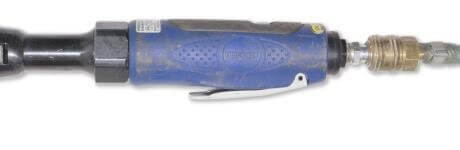
- Pneumatic socket wrench (optional for rapid installation)
Installing Quick-Lock BIG
Installation
Bringing in the sleeve
- Do not assemble the sleeve.
- Bring in the sleeve via the manhole entrance.

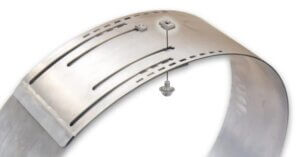
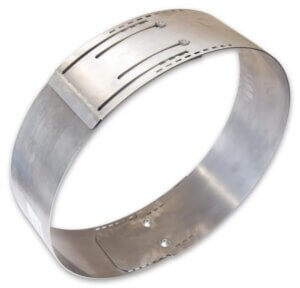
Putting the sleeve together
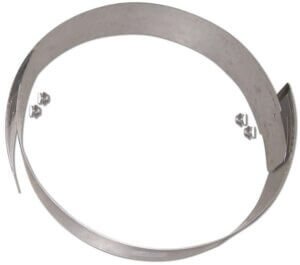
- Join the sleeve sections together so that the tracks punched out of them are on the outside.
- Place the sliding blocks in the tracks.
- Secure the sliding blocks with the locking screws.
- Adjust the sleeve to the smallest diameter and tighten the locking screws.
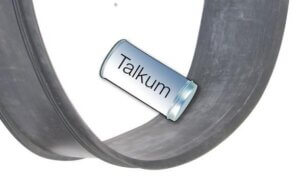
Applying talcum powder to the rubber jacket
- Apply talcum powder to the inside of the rubber
jacket.
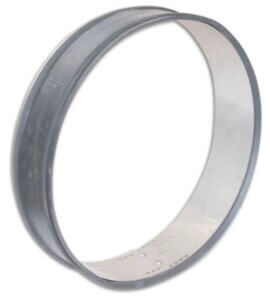
Preassembling the sleeve
- Pull the jacket over the sleeve until the tapered rubber edge lies on the steel sleeve.
- The preassembled sleeve is rolled so tightly that it can be taken into the pipe and turned around there.
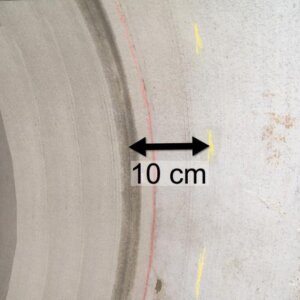
Marking out the position
- On one side of the damage, at a distance of 10 cm from the center (the sleeve length is 20cm), mark out the position of the sleeve all the way around the circumference of the pipe.
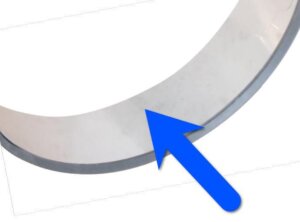
Positioning the sleeve
Position the sleeve so that the tapered edge of the rubber faces against the direction of flow.
Aligning the sleeve
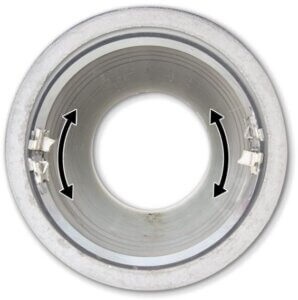
- Align the sleeve to the marking in the pipe.
- Turn the sleeve so that the locking screws are roughly level on the left and right sides of the pipe.
- The sleeve must always be installed perpendicular to the axis of the pipe.
- When using a spirit level, the pipe slope must be adjustable.
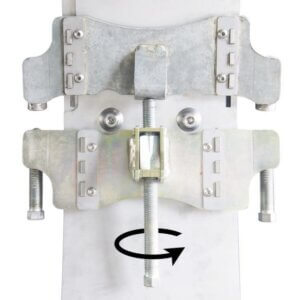
Attaching and securing the clamping tools
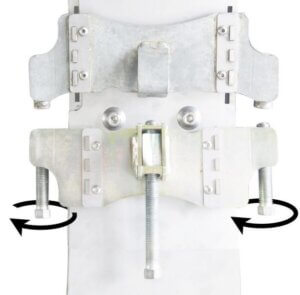
- The clamping tools on the left and right sides are identical.
- However, the clamping tools are aligned differently on the left and right: one of them points up and the other points down.
- Attach the two parts of each clamping tool as close together as possible.
- Tighten the spindles to hold the clamping tools in place.
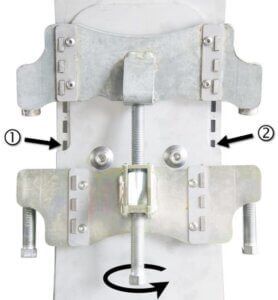
Expanding the sleeve
- Start on one side.
- Loosen the locking screws.
- Tighten the spindle to about half way until the sleeve is pressed against the pipe.
- When expanding the sleeve, make sure it opens up evenly.
- The easiest way to do this is to look at the
holes on the left (1) and right (2).
- Continue on the other side:
- Loosen the locking screws here too.
- Tighten the spindle to about half way.
Aligning to the marking
- Just before the sleeve is pressed to the pipe, align it once again to the marking or the axis of the pipe.
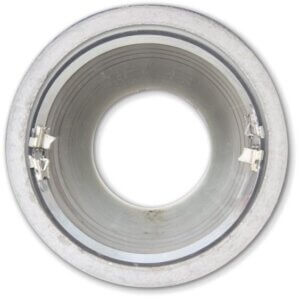
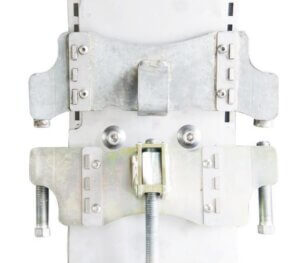
Repositioning the clamping tools
- Tighten the locking screws.
- Loosen the spindles.
- Reposition the two parts of each clamping tool as close together as possible.
- Fasten them with the clamping screws.
Clamping
- Keep working on both sides of the sleeve alternately:
- Loosen the locking screw.
- Tighten the two clamping screws evenly. Use the holes as a guide.
Tapping in
- While you are doing this, occasionally tap all the way round the sleeve with the mallet so that the tension is evenly distributed.
Note
The spindle is only designed for expanding the sleeve. The sleeve is clamped using the two clamping screws on the left and right of the tool.

Compressing to 12 mm / 13 mm
- Keep clamping until the added material (rubber
jacket + metal) is less than- 12 mm for DN 800 – DN 1300
- 13 mm for more than DN 1300
- Measure all the way round (< 12 mm/13 mm).
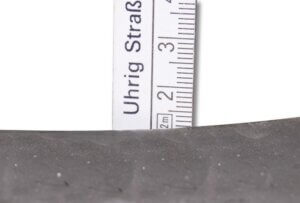
Eccentric expansion (if necessary)
- For minor joint misalignments, bends, or persisting leaks, the sleeve can be expanded eccentrically using the second clamping screw.
- Note: If the sleeve is expanded too eccentrically,
the tools can become jammed. - Use the holes as a guide.


Tightening the locking screws
- Make sure that the sleeve has reached its final state.
- Tighten the locking screws using the ratchet.
Removing the clamping tools
- Loosen the clamping screws of the tools.
- Remove the tools
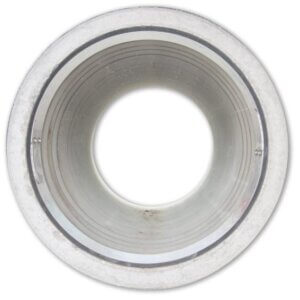
The Quick-Lock BIG sleeve now forms a tight and reliable seal.
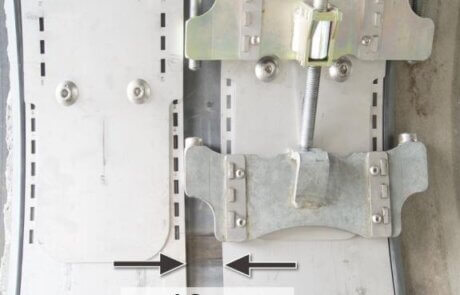
Serial installation
For longer areas of damage, serial installation is sometimes possible.
- We can supply a 25 cm wide rubber overlap, with each half between the actual seal and the pipe wall.
- The distance between the sleeves should be at least 40 mm in order to leave enough space for the
clamping tools. - When two BIG sleeves are installed in series, the tapered rubber edge on each one faces outwards.
- If more than two sleeves are installed in series, the tapered rubber edge must be trimmed off on the middle ones
Tool maintenance
Maintenance
- The spindles and clamping screws must be treated with high-pressure lubricant (Metaflux lubricating metal) after each use.
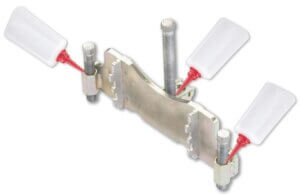
- Damaged retaining lugs can be replaced with the aid of the two socket screws.
4 Appendix 1
Technical data sheet
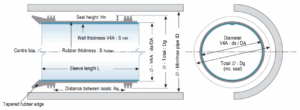
| Quick-Lock BIG sleeve DN |
x parts | Sleeve length |
Total diameter, rolled |
Suitable for pipes from / to |
Stainless steel sleeve | Rubber jacket | Total weight |
|||||
|---|---|---|---|---|---|---|---|---|---|---|---|---|
| Pipe ID min. |
Pipe ID max. |
Wall thickness s |
V4A pipe rolled da |
Max. expanded diameter DA |
Rubber thickness |
Height of seals |
Distance between seals |
|||||
| mm | mm | mm | mm | mm | mm | mm | mm | mm | mm | mm | kg | |
| Designation: | L | Dg | DN min | DN max | S V4A | da | DA | S Rubber | Hn | An | ||
| 800 | 2 | 200 | 738 | 770 | 830 | 3 | 710 | 815 | 3 | 11 | 140 | 17.9 |
| 900 | 2 | 200 | 838 | 870 | 930 | 3 | 810 | 915 | 3 | 11 | 140 | 19.7 |
| 1000 | 2 | 200 | 938 | 970 | 1030 | 3 | 910 | 1015 | 3 | 11 | 140 | 21.6 |
| 1100 | 2 | 200 | 1038 | 1070 | 1130 | 3 | 1010 | 1115 | 3 | 11 | 140 | 23.7 |
| 1200 | 2 | 200 | 1138 | 1170 | 1230 | 3 | 1110 | 1215 | 3 | 11 | 140 | 25.7 |
| 1300 | 2 | 200 | 1238 | 1270 | 1330 | 3 | 1210 | 1315 | 3 | 11 | 140 | 27.6 |
| 1400 | 3 | 200 | 1338 | 1370 | 1430 | 4 | 1310 | 1415 | 3 | 11 | 140 | |
| 1500 | 3 | 200 | 1438 | 1470 | 1530 | 4 | 1410 | 1515 | 3 | 11 | 140 | |
| 1600 | 3 | 200 | 1538 | 1570 | 1630 | 4 | 1510 | 1615 | 3 | 11 | 140 | |
| 1700 | 3 | 200 | 1638 | 1670 | 1730 | 4 | 1610 | 1715 | 3 | 11 | 140 | |
| 1800 | 3 | 200 | 1738 | 1770 | 1830 | 4 | 1710 | 1815 | 3 | 11 | 140 | |
Local support
Talk to the experts — 1800 028 584. SECA’s German factory-trained technicians support ROVION® from Sydney, Melbourne, Brisbane, Auckland & Christchurch.